 PARTY
PARTY
A credible party supplies manufacturer is not defined by a catalogue alone. Retailers and distributors need to know which processes are controlled, how a supplier manages mixed materials, and whether the same team can carry an approved sample through packing and shipment. This guide helps procurement teams compare suppliers on evidence rather than presentation.
1. Define the buying decision before requesting a quote
Begin with the sales channel and launch date. A party-store assortment, an e-commerce pack and a large retail program can all use similar items, but their barcode, carton, testing and replenishment requirements are different. The right manufacturing partner asks these questions before promising price or lead time.
For an accurate comparison, connect the product to the commercial outcome: the sales channel, customer profile, purchase quantity, required date and the way the item will be presented. Use our party supplies product range to shortlist categories, then carry those details into one controlled buying brief.
2. Build a specification a factory can act on
Strong sourcing work makes assumptions visible. The following points give a factory enough context to identify a viable route, prepare a relevant sample and explain which variables affect cost or timing.
- Legal entity, factory address and production scope that match the quotation and bank documents.
- Named contact for artwork, sampling, production checks and shipment handover.
- A product-level specification covering materials, size, print, pack count and retail presentation.
- A documented route for sample approval, in-line checks, final inspection and carton marking.
Keep the buyer requirements in a versioned file. If the order changes, update the file rather than relying on a message thread. This simple habit makes the sample, quotation and shipment inspection easier to compare.
3. Use factory testing to reduce rework
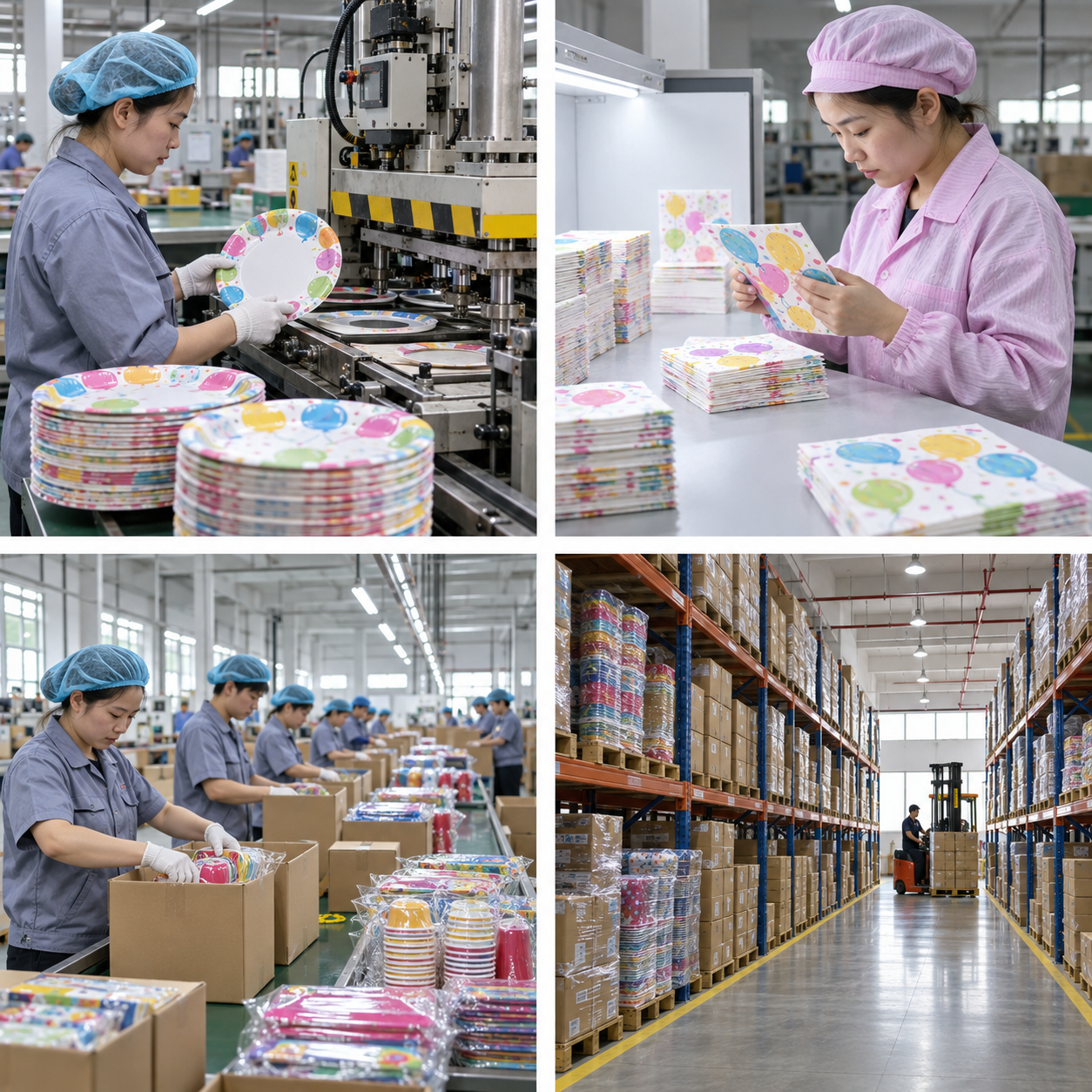
During factory review, ask to see the ordinary work rather than only a showroom: incoming material storage, print references, count stations, packing areas and records used to separate an approved item from a revision. For a mixed party collection, the most important signal is often whether color, pack count and carton details remain connected across categories.
Turn approval into an observable process
For party supplies manufacturer, the useful question is not simply whether a supplier performs quality control. Ask which checkpoint applies to the item, who owns the reference sample and what happens if a result differs from the approved brief. A photo alone is not a release decision; it should be tied to a sample, count, measurement, print reference or packing instruction that both sides can identify.
Keep the commercial and technical records connected. The quotation should describe the same pack count, material, artwork version and outer-carton assumption used for the sample. When a customer requirement changes, note the change before production continues. This creates a practical audit trail without turning a straightforward party program into unnecessary paperwork.
Ask for the evidence that matters to this product: physical sample checks, controlled artwork references, count-control steps and the shipment inspection point. A reliable answer is specific to the selected SKU, material and destination market.
Have a product reference, quantity and target market? Ask PartyHue for a product review before moving to bulk production.
4. Review the product in its real application
For a first order, choose a manageable product family instead of requesting every category in one launch. A plate, napkin, cup and decoration program can reveal how the supplier coordinates paper conversion, printing and packing. Once the specification process is proven, additional themes and seasonal variants are easier to control.
Before approving production, prepare the product the way a customer or warehouse will experience it. Set up a decoration, inflate a balloon, assemble a kit or review a full retail pack. This application review is often where small issues in count, color, presentation or instructions become clear.
5. Make shipment preparation part of the product plan
Before placing a purchase order, confirm the delivery point, outer-carton limit, shipping marks, destination labels and inspection timing. A factory can be capable of making the item yet still be a poor fit for a buyer whose warehouse or retailer needs precise packing data.
Compare landed-cost assumptions, not only unit prices
A quotation becomes useful when it can be compared on the same basis. Check the product and pack configuration, carton dimensions, gross weight, inspection scope, delivery term and destination assumptions. An apparently lower unit price can lose its advantage if the pack is inefficient, the carton data is incomplete or a required handling step was left outside the quote.
For each order, agree the cargo-ready definition, final inspection timing and release authority before the forwarder booking becomes urgent. Our factory and quality overview explains the practical checkpoints PartyHue uses to support export-ready party supplies.
Buyer FAQ
How can a buyer tell whether a supplier is a factory?
Compare the legal entity across business documents, quotation, bank beneficiary and any audit records. Then ask which process is performed in-house and which is subcontracted for the selected product.
Should the lowest quote decide the supplier?
No. Compare the same specification, packaging, sample route, inspection scope and delivery term. A lower quote can simply omit a detail that becomes costly later.
What should a first RFQ include?
State the target market, product reference, quantity by design, packaging, required date and any compliance or retailer requirements.
Conclusion
Send PartyHue the selected category, estimated quantities and market. We can map the practical sampling and production route before you commit to a range. For related sourcing questions, see the PartyHue buyer FAQ or contact our team with the product reference, quantity, destination market and launch date.
READY TO PLAN THE NEXT ORDER?