 PARTY
A frame-style arch is installation hardware; its approval should not be hidden beneath balloons or confused with a flexible garland strip. For an importer, retailer or event supplier, the useful comparison connects the customer-facing result with details that development, production and inspection teams can observe. The brief should separate product construction, pack contents, application assumptions and any claim that needs evidence.
Buy balloon arch stands by frame geometry, material, segment and connector design, base system, assembled dimensions and defined venue conditions. The buying specification should record assembled width and height, pole or tube dimensions, segment count, connector engagement, base dimensions and complete hardware count. Approve a representative physical sample and its retail pack together; a catalogue image or category name cannot prove fit, function, customer coverage or shipment condition.
1. Define the opening, venue and floor before choosing a frame
Define opening size, venue, floor, guest clearance and installation responsibility, then select one complete frame and base configuration before balloon styling. Define the destination market, sales channel, user group, quantity and required warehouse date before requesting a final quotation. Record assembled width and height, pole or tube dimensions, segment count, connector engagement, base dimensions and complete hardware count. If the intended application, material or pack changes after sampling, reopen the affected approval rather than treating the revision as an equivalent substitute.
An arch frame is installation hardware, not a finished balloon design. First define the usable opening guests or equipment need, the total footprint the venue permits, the floor surface and whether the setup is indoors or outdoors. A frame chosen from a styled photograph may hide bases, supports and depth behind balloons. Request an unobstructed image or drawing of the assembled structure before comparing models.
Treat venue conditions conservatively. Do not assume an indoor frame can be moved outside because it appears heavy, and do not infer wind performance from a base photograph. Follow the selected product's documented conditions and the venue plan. If outdoor use is contemplated, the responsible event professional should assess site, weather, anchoring permissions, public access and emergency routes rather than relying on a generic supplier statement.
Use the PartyHue product range to identify a physical reference, then place the selected construction, market and intended application in the same RFQ.
2. Document geometry, segments, joints and complete hardware
Use a dimension drawing that distinguishes total width and height, usable opening, base footprint, frame depth and any adjustable range. Record material, pole or tube section, segment lengths, connector design, fasteners, base construction and total component count. If water-fill bags, fabric covers, clips or balloon attachments are optional, list them separately so the quoted kit is unambiguous.
Number pole sections and hardware bags when left and right parts or curved segments are not interchangeable. Instructions should show full connector engagement and required tools. State whether balloons, pumps, glue dots and decorating strip are excluded. A frame-style arch and a flexible garland strip are different products even when both listings use the phrase balloon arch kit.
Minimum details for a comparable quotation
- Frame material, geometry, pole or tube dimensions, segment count, joints, connectors and fasteners.
- Assembled width, height and depth, base design and dimensions, mass and interface with the frame.
- Defined venue and floor conditions, balloon attachment route, setup tools, instructions and supervision.
- Numbered hardware bags, model label, spare parts, protective sleeves, carton dimensions and handling marks.
Compare complete installed systems instead of headline height
A low frame price may exclude bases, fasteners, carry bags, instructions or the connectors shown in styled photographs. Require a bill of materials beside the quote and mark every optional component. Compare the assembled opening and footprint rather than the tallest pole. If one model needs additional venue-approved support, include that installation requirement in the commercial comparison instead of treating it as an unrelated event expense.
Freight can change the ranking of frame options. Long pole sections may create oversize cartons, while heavy bases increase handling and local delivery costs. Ask for packed length, carton dimensions, gross weight and number of cartons from the production pack. A sectional frame with more connectors may ship efficiently but require more setup time; a longer rigid pole may assemble faster but create a difficult warehouse item.
MOQ is often model-specific because pole sections, base plates and connectors form one hardware system. Mixing geometries to reach a combined quantity can create unusable spare parts. Quote complete kits by model and define a separate spare-parts list. A reasonable spare policy supports field service, but it should not hide recurring shortages or make the buyer assemble saleable kits from a general hardware carton.
Include lifecycle handling in the buying decision when the frame is intended for repeated professional use. Ask how poles are cleaned, dried, labeled and stored between events; whether connectors can be replaced individually; and how damaged parts are identified. Do not promise an arbitrary number of uses. A service log with setup observations and replaced components is more credible and helps the owner retire a damaged section before it reaches another venue.
A setup video can support instructions but should not replace the parts list or dimension drawing. Film one uninterrupted assembly of the approved production model and show bases, connector engagement and required tools before decoration is added. Avoid editing out difficult steps or showing extra hardware that is not supplied. The resulting reference helps train installers and gives customer service a consistent way to identify where an assembly question occurred. Date the video and display the model code at the start; otherwise an older frame revision may quietly become the instruction for new hardware. Archive superseded instructions when a connector, base or segment changes. Keep the current revision accessible to installers.
Questions to resolve before the purchase order
- Does the quote include every pole, connector, fastener and base required for the photographed assembly?
- Are usable opening, total dimensions, base footprint and packaged length defined with diagrams?
- Have setup labor, venue conditions, freight dimensions, carton weight and storage length been compared?
- Are model-specific spares listed separately without being counted as components of each complete kit?
3. Assemble the bare structure before adding balloons
Inspect the bare frame before styling
Assemble all segments and bases on the defined level surface, verify joints are fully engaged and measure the opening. Only then add the intended lightweight balloon arrangement. A decorative finished photo cannot reveal a missing fastener or poorly seated connector.
Risks include mixed model parts, shallow connector engagement, bent poles, missing fasteners, bases omitted from photographs, unsubstantiated weather claims and cartons too weak for heavy components. Record the sample condition, method and result instead of using a vague pass/fail note. Link photographs and observations to the exact SKU, size, color or batch that was reviewed.
Assemble the complete bare frame on the defined level surface. Measure the opening and footprint, inspect every connection and check that bases sit as intended. Apply only the lightweight balloon arrangement planned for the product, then observe whether styling pulls connectors out of alignment. Do not use hanging weights or improvised loads to create an unsupported capacity claim. The purpose is to verify assembly and application, not to certify structural engineering.
4. Inspect model-specific parts and repeatable connections
Measure and fully assemble the selected frame, inspect joints and bases, reconcile fasteners and model-specific parts, and document the approved configuration before styling. Shipment inspection should also verify numbered hardware bags, model identity, instructions, spare-parts policy, base protection, carton strength and gross weight. Ask which sample, artwork revision and measurement method the inspector will use. Any report or certificate should apply to the selected product and destination requirements rather than being presented as a general factory endorsement.
Model mixing is a common hardware risk. Compare every pole, connector, base and fastener with the bill of materials before packing. Fully assemble representative kits from production cartons rather than a workshop reference set. Inspect bent poles, damaged threads, shallow push-fit engagement, missing holes and finish damage at interfaces. Record the model code on instructions, inner hardware bags and carton labels.
A complete-kit count should be functional. Four loose screws do not complete a frame if the matching nuts or base plate are absent. Use a layout board or counted compartments for small hardware, then seal and label the bag. Define the spare-parts policy without silently using spares to correct routine shortages in every inspected kit.
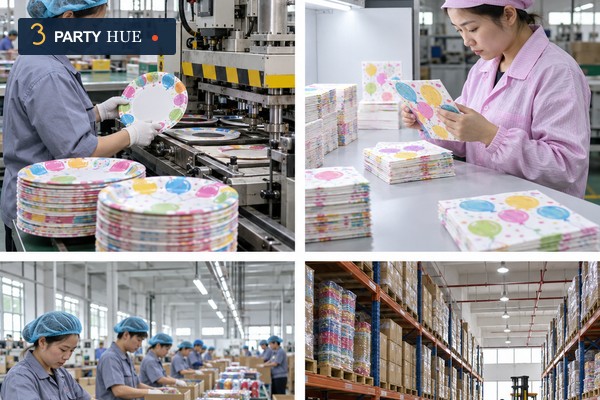
Have a physical reference, quantity and target market? Send the selected product details to PartyHue before approving bulk production.
5. Plan installation, guest clearance and dismantling
Use trained setup staff, maintain guest and exit clearance, inspect connections before use and do not extend the frame or change venue conditions beyond the selected product instructions. Prepare one realistic setup using only the contents of one retail unit unless the image clearly states that multiple packs are shown. Record tools, supports, preparation time and supervision needs. Follow the selected product's instructions and relevant venue or destination-market requirements.
Installation planning begins before the decorators arrive. Reserve enough floor area for bases and staff, keep exits and circulation routes clear, and protect venue surfaces. Assemble and inspect the structure before balloons conceal joints. If the instructions require two people or a tool, communicate that in the listing and event schedule. Trained staff should control the area while sections are raised or dismantled.
The balloon recipe affects setup time and visual coverage but should not be confused with frame stability. Record balloon sizes, approximate quantity, attachment route and where clusters add asymmetric pull. Prepare damaged-balloon replacements without overloading one frame area. At dismantling, remove decoration progressively so staff can see connections and keep poles from dropping or scraping the floor.
6. Illustrative case: two six-foot arches with different openings
Illustrative sourcing case: a decorator compares two arch frames sold under the same height. One measurement excludes bases and the other states the opening after assembly. The buyer standardizes the measurement diagram and requires a bare-frame setup before selecting the model. The buyer records the decision in the specification, requests a revised physical sample and updates the listing before production. This hypothetical exercise explains a procurement method; it is not a PartyHue customer testimonial or a claimed sales result.
Two suppliers quote an arch described as six feet high. One value measures the highest curved pole without bases; the other gives the total assembled height and a narrower usable opening. The buyer replaces the headline dimension with one common drawing and asks both suppliers to assemble bare frames. The comparison then focuses on the opening and footprint that the venue actually needs.
7. Pack poles, connectors and bases for controlled receiving
Separate heavy bases from delicate poles, protect threaded or push-fit interfaces and state carton gross weight and handling orientation accurately. Before release, reconcile sellable-unit count, SKU label, barcode or destination identification, inner packing and carton marks with the purchase order. A visually correct sample is not shipment-ready when pack data or carton protection differs from the approved route.
Protect pole ends, threads and push-fit interfaces with sleeves or dividers. Heavy bases should not move freely against light poles, and the carton gross weight must be practical for the chosen handling route. Long cartons may require special warehouse positions even when their total mass is modest. State the package length early so freight and storage teams can plan accurately.
At receiving, lay out every component, reconcile hardware bags and assemble a representative frame before accepting model identity. Check instructions, dimensions, finish and protective packing. Photograph carton and pole damage before straightening or repair. Keep one complete reference kit labeled and separate; hardware borrowed from it can hide shortages in normal stock.
Receiving checks for the approved product
At receiving, keep one retail unit unopened and use another for the agreed fit, assembly or application check. Compare model identity, every pole and connector, fasteners, bases, assembled dimensions, instructions, protective packing and carton weight with the retained reference. Photograph discrepancies before altering the product, identify the affected carton or lot where available, and distinguish transit damage from construction or packing observations. For a reorder, approve changes to material, dimensions, artwork, components or pack count as controlled revisions.
For an independent reference relevant to this product, see the U.S. CPSC toy safety guidance. Apply independent guidance to the exact material, construction, intended use and destination rather than treating a category page as approval for every SKU.
Additional independent references
8. Buyer FAQ
Is an arch frame the same as balloon strip?
No. A frame is support hardware; a strip is an attachment accessory within a different installation route.
Should dimensions include the bases?
Use a diagram that clearly defines total and usable opening dimensions after full assembly.
Can every arch stand be used outdoors?
No. Follow product-specific documented conditions and the venue plan; do not generalize from appearance.
Is a balloon arch frame suitable for outdoor use?
Only when the selected product documentation and a venue-specific plan support those conditions. Weather, surface, anchoring permission and public access require a separate risk assessment; appearance or base weight alone is not enough.
Which dimensions should a wholesale listing show?
Show total assembled width and height, usable opening, depth and base footprint on one drawing. Explain whether measurements include bases and whether the frame is adjustable.
How can missing hardware be prevented?
Use a model-specific bill of materials, counted and labeled hardware bags, representative full assembly from production cartons and receiving checks that count functional pairs rather than loose pieces only.
Conclusion
Send PartyHue your arch opening, venue, frame model, base route and order quantity for a hardware review. For related sourcing questions, see the PartyHue buyer FAQ or send the exact product reference, quantity, destination market and required date to info@partyhue.com.
READY TO PLAN THE NEXT ORDER?